
How Much Does a Massage Therapy Website Cost

Short answer: a massage therapy website costs between $0 and about $5,000, and where you land depends almost entirely on whether you're paying with money or with your own evenings. A do-it-yourself builder runs a few hundred dollars a year. A custom-built site from a developer generally starts around $1,500 up front, or $125 a month if you'd rather not pay a lump sum.
That's the range. The more useful question is what you actually get at each price, and which one makes sense for a treatment room that needs to stay booked. Here's the honest breakdown, including what we built for a real studio here in Michigan.
Table of Contents
- The Short Answer, In A Table
- What Actually Drives The Price
- The Three Ways To Buy
- Do I Need A Website If I Already Use Vagaro Or Mindbody
- A Real Example From Revive Massage And Meditation
- What To Ask Before You Hire Anyone
The Short Answer, In a Table
| Option | Typical cost | Best for |
|---|---|---|
| DIY site builder | ~$200–$600/year | Brand-new solo practice, zero budget |
| Booking platform's built-in site | Often bundled with your subscription | Testing the water before committing |
| Template freelancer or WordPress build | ~$1,000–$3,000 up front, plus hosting and maintenance | Established practice wanting something custom-ish |
| Custom hand-coded build | From $1,500 one-time, or $125/month all-in | Studios competing on local search that need speed and control |
Ranges for the first three are typical market pricing and will vary by who you ask. The last row is our own web design pricing, so that one I can state precisely: $125/month with $0 down, hosting, unlimited edits, and bi-weekly SEO updates included, or $1,500+ for a one-time build you own outright.
What Actually Drives the Price
Most quotes vary because of five things, not because one developer is greedier than another:
- Page count. A single-page site for a solo LMT is a fraction of the work of a studio site with a service menu, therapist bios, class schedule, and gift certificate flow.
- Booking integration. Dropping a link to your scheduler is trivial. Embedding it properly, styling it to match your brand, and making "Book Now" reachable from every screen takes real work — and it's the single highest-leverage thing on a wellness site.
- Content and photography. If you hand over finished copy and good photos of your space, you save money. If someone has to write your service descriptions and source images, that's billable time.
- Whether it's built or assembled. A template costs less because someone already did the design. A custom build costs more because nobody has.
- What happens after launch. This is the one people forget. A $1,200 site that costs $90/month to maintain is not cheaper than a $125/month site that includes maintenance. Ask about year two before you sign anything.
The Three Ways to Buy
DIY builders (Wix, Squarespace, and friends.) Cheapest in dollars, most expensive in hours. You'll get something presentable in a weekend. The tradeoffs are real, though: these platforms generate heavy pages that load slowly on phones, and page speed is a ranking factor Google has been explicit about. If your budget is genuinely zero, this beats having no website. Just know you're renting, and the SEO ceiling is low.
A template freelancer or WordPress build. The middle path, and the most variable in quality. You can get excellent work here. You can also get a site built on six plugins that break the first time one of them updates, handed off with no maintenance plan. If you go this route, ask specifically what happens when a plugin breaks and who pays for the fix.
A custom build. More money up front, and worth it in one specific situation: when you're competing for local search traffic against other studios in your city. Hand-coded sites load faster, are easier to optimize, and don't carry the bloat that drags builder sites down. If "massage near me" in your town is a competitive search, this is where the difference shows up. That's the case we make in detail on our massage therapy web design page.
Do I Need a Website If I Already Use Vagaro or Mindbody
This is the most common objection we hear, and it deserves a real answer rather than a sales pitch.
Your booking platform is excellent at one job: taking an appointment from someone who has already decided to book with you. It's poor at a different job: convincing someone who has never heard of you that your studio is the right one.
Think about how the decision actually happens. Somebody's back has been bothering them for a week. They search "massage near me," get a list of studios, and spend maybe forty seconds on each before narrowing it down. In those forty seconds they want to know what you charge, what modalities you offer, who's going to be in the room, and whether the place looks calm. A booking widget answers none of that. A booking platform's stock template answers some of it, in a layout identical to every other studio using the same platform.
The practical setup: your website does the convincing, your booking platform does the transaction. They aren't competitors. A good site sends warm, already-sold traffic into the scheduler you're already paying for. We integrate with Vagaro, Mindbody, Square Appointments, Jane App, and Acuity for exactly this reason — there's no need to move your business anywhere.
The one case where you can skip a website: you're fully booked on referrals alone and want to stay that size. That's a legitimate business, and nobody should sell you a site you don't need.
A Real Example from Revive Massage and Meditation
Rather than describe a hypothetical, here's a studio we actually built for.
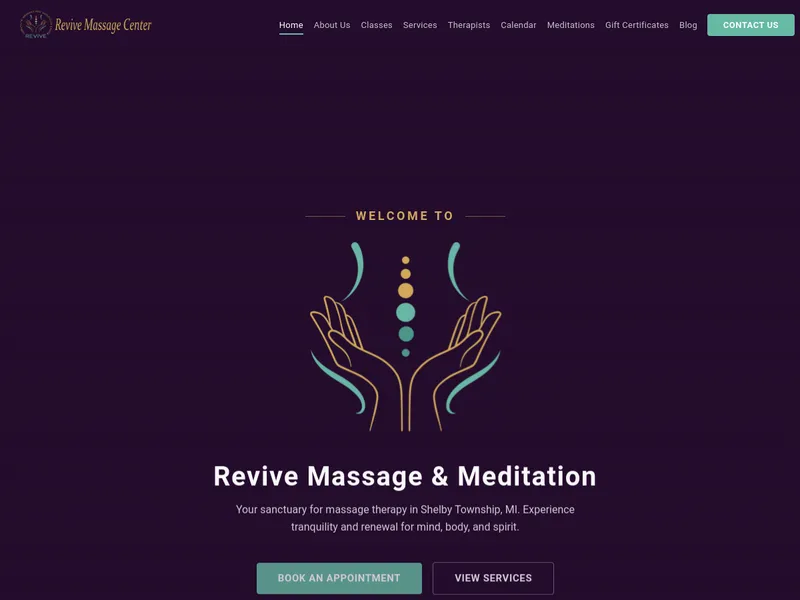
Revive Massage & Meditation is in Shelby Township, Michigan. They run two things under one roof — hands-on massage therapy and guided meditation sessions — which is a harder design problem than it sounds. Present them as one blended offering and you confuse people looking for a deep tissue appointment. Split them too hard and the studio reads as two businesses sharing an address.
What the build came down to:
- Online booking wired into their scheduler, reachable from every page rather than parked on a contact page
- Class and meditation schedules laid out so someone can find a session and commit in a single visit, without a phone call
- Gift certificates surfaced on the homepage — for a massage business, gift cards are a serious revenue line, and they spike hard from November through February. Burying them in a submenu during your best selling season is a genuinely expensive mistake.
- A calming custom design, hand-coded rather than pulled from a spa template, so it doesn't look like the studio one town over
- Local SEO groundwork for Shelby Township and the surrounding Macomb County area
Here's what the owner said afterward:
"We can't be happier with our website Lakeview Web Development built for us. We have gotten so many compliments from our clients on the look as well as how easy it is to navigate. When we need things added or changes on the site, Stevan gets it done within 24hrs. I highly recommend!"
— Alice H, Owner, Revive Massage & Meditation
That last part matters more than it sounds. Wellness businesses change constantly — seasonal packages, a new therapist, holiday hours, a class that moves to Thursdays. If every small edit means a support ticket and a two-week wait, the site drifts out of date and quietly starts costing you bookings. Unlimited edits with a 24-hour turnaround is the reason their schedule and pricing are never wrong.
You can see the finished site and the rest of our work on the projects page.
What to Ask Before You Hire Anyone
Whoever you end up hiring, including us, get these answered in writing first:
- What does year two cost? Hosting, maintenance, edits, domain. Get the full annual number, not just the build price.
- Who owns the site? If you part ways, do you keep the files and the domain, or start over?
- How do edits work, and what do they cost? Ask for the actual turnaround time, not a vague "quickly."
- Will it integrate with my existing scheduler? Confirm your specific platform by name before you sign.
- What's the mobile load time? Ask them to run your current site through Google PageSpeed Insights and show you the number they're aiming for.
- Can I see a site they built in a similar industry? Not a portfolio mockup — a live site with a real business behind it.
Any developer worth hiring will answer all six without hesitating.
The Bottom Line
If you're just starting out and money is genuinely tight, a DIY builder is a reasonable first step and beats not existing online. If you're an established studio trying to win local search in your city, a custom build pays for itself in booked appointments — provided it's fast, easy to update, and wired into the scheduler you already run.
We build websites for massage therapists, day spas, med spas, and wellness clinics across Michigan, starting at $125/month with hosting and unlimited edits included. If you'd like a straight answer on what your specific situation would cost, get in touch — no pressure and no obligation, and if a DIY builder is the right call for where you are right now, we'll tell you that too.